

I spent most of my early career as a Human Resources professional, supporting organisations to remain internally and externally desirable to existing and prospective stakeholders. One of the aspects of my work that I cherished most was closely supervising and actively participating in Business Process Reengineering (BPR) interventions – both as an employee and later as an external consultant. I found the process deeply intriguing. The resulting SWOT analyses often laid bare exactly what needed to be done, urgently and sustainably, for organisations to achieve, maintain, and optimise their desired outcomes.
A few years later, while trying to strategise a new roadmap for my life after being prematurely pushed out of paid employment, I found myself trapped at an identity level where I could neither define myself outside the job I once held nor see a meaningful future beyond it. At that point, I genuinely believed there was nothing left to live for.
Thankfully, the suicidal thoughts did not last long because I instinctively anchored myself to my immediate family.
However, as I spent more time in deep introspection, searching for a pathway forward, I realised that I had once again anchored my identity to something outside myself. This time, it was my husband and children. Just as I had previously defined myself by a job title, I was now defining myself by family roles. But the thought of my children eventually growing up and leaving to build lives of their own became even more terrifying.
That anchor, too, proved unstable. I eventually realised that I had to anchor myself to something from within. I had to stop defining myself by external things – a job, a bank account, a spouse, children, social status, influence, possessions, networks, or appearances.
I needed to define myself from WHO I WAS WITHIN.
Something intrinsic.
Something I could build from.
Something I could lose and still recreate – FROM WITHIN.
As I continued reflecting, memories of the years I had spent helping organisations and clients through Business Process Reengineering suddenly resurfaced. Then one question hit me:
If organisations invest enormous time, expertise, and resources into Business Reengineering to periodically review:
- Who they are (Identity),
- Where they are (Current Reality),
- Where they desire to get to (Vision),
- What they need to get there (Strategy),
- And how they intend to execute it (Action),
why do individuals rarely prioritise themselves with the same intentionality?
Business Reengineering processes require deep analysis, strategic evaluation, and deliberate execution. They demand the identification of strengths, weaknesses, opportunities, and threats to optimise performance and sustain relevance. So why shouldn’t individuals do the same for their own lives?
Why shouldn’t we intentionally evaluate and redesign ourselves to maximise our talents, strengthen our capacities, improve our outcomes, and create meaningful personal fulfilment and social impact?
That moment became my turning point. I realised that if I was going to survive, thrive, and become truly impactful again, I had to intentionally redefine and reposition myself.
That was how the Self-Reeingineering concept was born.
The Definition
Self-Reeingineering is the intentional process of redesigning the way you think, behave, engage, and evolve so you can live, lead, and perform at higher levels of purpose, effectiveness, and impact. It is a continuous cycle of self-awareness, intentional growth, strategic action, evaluation, and mastery.
Self-Reengineering helps individuals move beyond merely surviving external realities and begin intentionally engineering internal capacity. The goal is to increase personal effectiveness, adaptability, resilience, and intentionality so individuals and organisations can achieve meaningful goals, sustain relevance, and maximise impact.
By continuously reviewing and refining their mindset, behaviours, systems, and strategies, individuals become better equipped to adapt to changing realities, meet evolving demands, optimise their strengths, and build lasting significance and legacy.
The Model
The Self-Reeingineering Model is a structured 7-phase transformational framework designed to guide individuals from
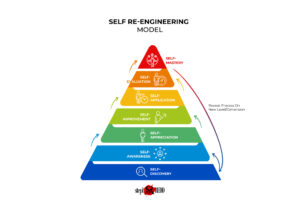
states of unconscious limitations to progressive levels of clarity, competence, confidence, and mastery. It is a unique self-actualisation process that enables individuals to carry out a deep personal strategy – one that helps them reset, reposition, reach for, achieve, and sustain meaningful aspirations.
The model deepens self-awareness, strengthens self-belief, and empowers individuals to engage with life, leadership, relationships, career, and purpose with greater intentionality, consistency, and impact.
By helping individuals activate their inner genius and align personal capacity with intentional action, the Self-Reengineering Model supports both individuals and teams in achieving meaningful, sustainable, and high-impact outcomes.
The 7 Steps of Self-Reeingineering
1. Discover: This is the exploratory phase where you ask yourself deep and sometimes uncomfortable questions that help you better understand “WHO YOU ARE” and “WHO YOU HAVE BECOME”. It is a process of intense personal excavation that requires honesty, reflection, and openness to new awareness. The questions may vary from person to person and may uncover truths that feel confronting or unsettling. Nevertheless, this phase is crucial because transformation begins with discovery. You cannot intentionally transform what you are unwilling to honestly confront.
2. Awareness: This is the phase of consciousness and recognition. Here, you become aware of your strengths, limitations, competencies, behaviours, patterns, possibilities, and realities. It is the point where hidden truths become visible and unconscious patterns are brought into conscious recognition.
However, self-awareness can be very complex. Although it is a place of conscious recognition, it is also a double-edged sword.
On one side, awareness can confront you with the painful realisation of how unaware you have been for so long. That awakening may trigger deep regret, shame, withdrawal, self-sabotage, emotional paralysis, or even a sense of hopelessness. Sometimes, the weight of seeing yourself clearly for the first time can feel overwhelming.
On the other side, self-awareness can become the catalyst for transformation. You become conscious of what you were previously oblivious to and you make a deliberate decision to grow, improve, evolve, and change. Instead of drowning in regret, you choose responsibility, intentionality, and transformation.
Whatever you discover at this stage is valuable because awareness gives you the power to make one of the most pivotal decisions of your life:
– Will I REMAIN the same, or will I choose to CHANGE?
If you choose change, then this becomes the phase where you define your desired outcome and intentionally set goals for growth, transformation, and achievement.
So, awareness, by itself, is neither positive nor negative. Its impact depends largely on what you choose to do with it. It can either become:
-
- a doorway to self-destruction,
- or a pathway to conscious change and personal transformation.
3. Appreciation: This is the phase of non-judgemental recognition and acknowledgement. Self-appreciation involves recognising your efforts, progress, sacrifices, strengths, commitment, potential, and value – regardless of whether your outcomes are currently perfect.
Appreciation sustains intrinsic motivation, optimism, resilience, and healthy self-worth. It reminds you that growth is not built solely on criticism, but also on recognition.
4. Improve:Awareness without action changes nothing. This is the phase where intentional work begins. Here, you identify the specific adjustments, disciplines, behaviours, systems, and habits required for the growth and advancement you desire.
Three critical questions guide this phase:
-
-
- What must I START doing?
- What must I STOP doing?
- What must I IMPROVE?
-
This is where strategy becomes transformation.
5. Apply: This is the engagement phase. It is the stage where you turn your learning to action by testing your growth, stretching your capacity, and intentionally showing up.
This is where you –
- Take that examination.
- Go for that interview.
- Ask for the opportunity.
- Start the business.
- Write the book.
- Have the difficult conversation.
- Show up for the dream.
Growth cannot become reality without application. So, SHOW UP AND GET IT DONE.
6. Evaluate: This is the assessment and reflection phase. Here, you intentionally evaluate your actions, results, growth, and outcomes against the goals you previously set.
Evaluation helps you determine:
- what worked,
- what failed,
- what should be repeated,
- what should be adjusted,
- and what requires deeper development.
If your desired outcome has not yet been achieved, the process begins again with Awareness, followed by intentional refinement and continued growth.
But if your goal has been achieved, you advance into the next phase: Mastery.
7. Mastery: This is the phase of attained competence, confidence, and refined capability. Mastery represents expertise at your current level of growth and achievement. However, mastery is never final because growth is continuous.
At this stage, you must decide, yet again:
– Will you REMAIN at your current level, or will you STRETCH toward a new one?
If you choose a new level, then a new goal must be set, and the Self-Reengineering process begins again.
Ultimately, Self-Reengineering is not a one-time event. It is a lifelong cycle of becoming and rebecoming – an intentional process of evolving into one’s most aware, capable, and impactful self for every new level of life, leadership, responsibility, and achievement.
It is designed to help individuals develop the clarity, capacity, resilience, and adaptability required to successfully navigate the complexities of different phases of life while remaining purposeful, effective, and impactful.
The i-SWOT PIE Framework
Drawing from the adapted principles of the SWOT Business Reengineering Model, the Self-Reengineering process incorporates the i-SWOT PIE Framework to empower individuals to:
- Acknowledge and embrace their distinct personal Identity;
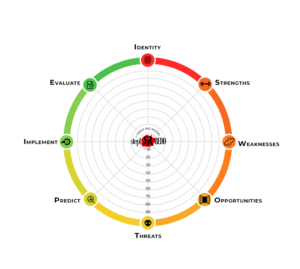
- Identify and intentionally deploy their Strengths resourcefully;
- Recognise their Weaknesses and develop strategies to manage, reduce, or transform them into areas of growth;
- Prepare for, identify, and maximise Opportunities that align with their strengths and aspirations;
- Anticipate, withstand, and overcome existing or potential Threats to their growth and progress;
- Predict desired outcomes through intentional and inspiring goal-setting;
- Develop and Implement practical strategies for effective execution and achievement; and
- Periodically Evaluate performance, outcomes, and progress to determine what should be sustained, refined, improved, or eliminated.
As a core component of the Self-Reengineering Transformational Process, the i-SWOT PIE Framework enables individuals to move toward self-actualisation and sustained personal mastery with greater clarity, intentionality, alignment, and measurable progress.
When last did you intentionally pause to evaluate yourself? To examine who you are becoming, what is shaping you, and whether your current path aligns with your deeper purpose and potential?
Transformation does not happen accidentally. It requires awareness, strategy, courage, and intentional action.
I invite you to begin your Self-Reeingineering journey today.
Ease in with the SPOT-Me Guided Self-Coaching Audio – your companion for intentional reflection, clarity, growth, and transformation. Or take a deeper dive by enrolling in the online Self-Reengineering Course.
Your next level will not emerge by chance. It will emerge by design.
Never Give Up on You. Stay Genius.
— StephREDD